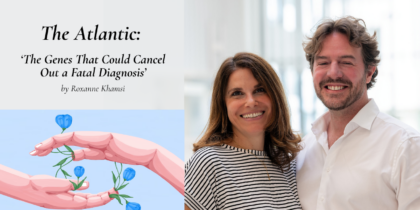
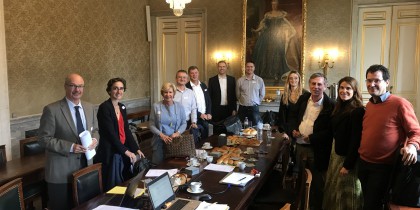
EURORDIS, Rare Diseases Europe, features an article on Aurélien and the work of 101 Genomes

EURORDIS, the leading voice for rare disease patients with European institutions, researchers, health authorities, and industry, has dedicated a publication to Aurélien and the work of 101 Genomes.
“When Romain Alderweireldt’s son was diagnosed with neonatal Marfan syndrome, doctors told the family he might only have five months to live.
Instead of resigning himself to the lack of answers, Romain set out to find them.
What began as a father’s determination to understand his son’s illness gave birth to GEMS-App: an innovative platform allowing people with Marfan syndrome to contribute to genomic research safely, remotely, and on their own terms.
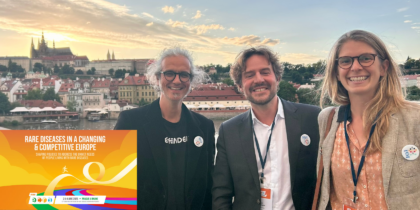
At #ECRD2026, Romain’s project won the ‘Poster Pitch’ competition, recognizing not only an innovative approach to rare disease research but also the extraordinary power of patient-led innovation.”
👉 Read the full article: GEMS-App and the search for answers in Marfan syndrome – EURORDIS-Rare Diseases Europe”
UNOFFICIAL TRANSLATION OF THE EURORDIS PUBLICATION
The GEMS app and the quest for answers regarding Marfan syndrome
June 2026. When Aurélien, the son of Romain Alderweireldt, was born, his wife, Ludivine, immediately felt that something was wrong. Some doctors also had the impression that something was amiss. Yet, throughout hospital consultations, the family saw a succession of doctors and other professionals who assured them that their son was not ill. It took 11 months before Aurélien received a diagnosis of neonatal Marfan syndrome, a rare connective tissue disorder caused by a genetic variant affecting the production of fibrillin-1.
Fibrillin, Romain explained, is a bit like “the glue that holds all your cells together and to your body.” When this “glue” does not function correctly, the disease can affect almost every system in the body. Among its most serious complications are those affecting the aorta, the main artery that carries blood from the heart.
The family was told that children with this condition often had a life expectancy of about 16 months. “We truly felt that he was going to die five months later,” he recalls.
Facing an uncertain and devastating future for his son, Romain, who has a background in law, immersed himself in genomics and scientific research. “My first reaction was: I must understand what happened to my son.”
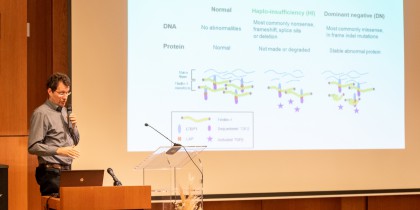
This question eventually led to the creation of the GEMS app by the 101 Genomes Foundation, the project he presented at ECRD 2026—which won him the poster presentation competition on the first day.
This application stems from a well-known challenge in rare disease research: how to collect and share enough high-quality data across borders while ensuring that participants remain informed and in control. Rare disease research often relies on pooling data from people who may live far apart, speak different languages, and be cared for in different healthcare systems.
While the General Data Protection Regulation aimed to facilitate secure data sharing, Romain believes its complexity has too often made this data harder to utilize. “It wasn’t supposed to turn data into gold that you deposit in the bank,” he stated. “Data is perishable, and if it isn’t used, it loses its relevance.” According to him, new regulatory frameworks such as the Data Governance Act and organizations recognized for data altruism can help overcome some of this hesitation. But in the case of rare diseases, any uncertainty that slows down responsible data sharing can also hinder the search for desperately needed answers.
The GEMS-App was designed to address this issue. It is a secure online platform that allows people with Marfan syndrome to participate remotely in genomic research, provide informed consent, update that consent over time, and share their data in a controlled manner. In practice, a participant can register online, read and approve consent documents, complete questionnaires about their health status and medical history, and then receive a home DNA collection kit. Once the sample is returned, their genomic and clinical information can contribute to the study, while allowing them to manage their consent over time.
For Romain, this type of data sharing is not an abstract technical issue, but an essential element in finding answers. The application was developed as part of the GEMS study, which seeks to understand why people with Marfan syndrome, including those with similar or identical FBN1 gene variants, can experience radically different cardiovascular outcomes. This variation suggests that other parts of the genome might contain protective factors or modifiers that could, one day, pave the way for new therapeutic approaches.
” We need more and more data. Perhaps someone possesses a key element within their genome. ”
Although it is still in its early stages, the GEMS-App has already shown great promise. The platform has been approved by several ethics committees for its transparent consent approach and now has over 200 users. A related poster presented at the ECRD, titled “Identification of potential modifiers of Marfan syndrome through pathogenicity predictions by variant combination,” also showed how GEMS-linked data can help identify the genes that explain why the severity of Marfan syndrome varies so much.
In this regard, GEMS-App could become a model not only for Marfan syndrome research but also, more broadly, for rare disease data collection: a way to allow people to participate remotely, safely, and actively in research that might be impossible without international collaboration.
Now about ten years old, Aurélien has far exceeded the life expectancy initially announced to his family. Two weeks before the interview, he had spent fifteen days in the hospital to undergo one of his most painful operations. “He is still in pain, he is still on a lot of medication,” Romain said. “But he keeps smiling. It’s incredible.”
” He is truly the one who guides us. And when I say ‘us,’ I mean my wife, myself, my daughters, and the whole family. ”
When Romain and Ludivine launched this project, they did not expect it to save Aurélien. “We wanted his life to have meaning,” he explained. ” Originally, it was truly intended to help others in the same situation as him. We didn’t dare dream that it could save him, but today, Aurélien is proud of 101 Genomes, which has had a very positive impact on him, and we remain hopeful. ”
As research progresses, the family is beginning to hope that the data collected via the GEMS-App could one day contribute to new therapeutic approaches, including drug repurposing.
For Aurélien, some discoveries may come too late. Yet, the work continues with the same goal: to help others born with Marfan syndrome and other rare heart diseases, so that they and their families can benefit from better answers, better options, and a better quality of life.”
UNOFFICIAL TRANSLATION OF THE EURORDIS PUBLICATION
Cette publication est également disponible en :