Fonds Baillet-Latour honors Professors Julie De Backer and Catherine Boileau

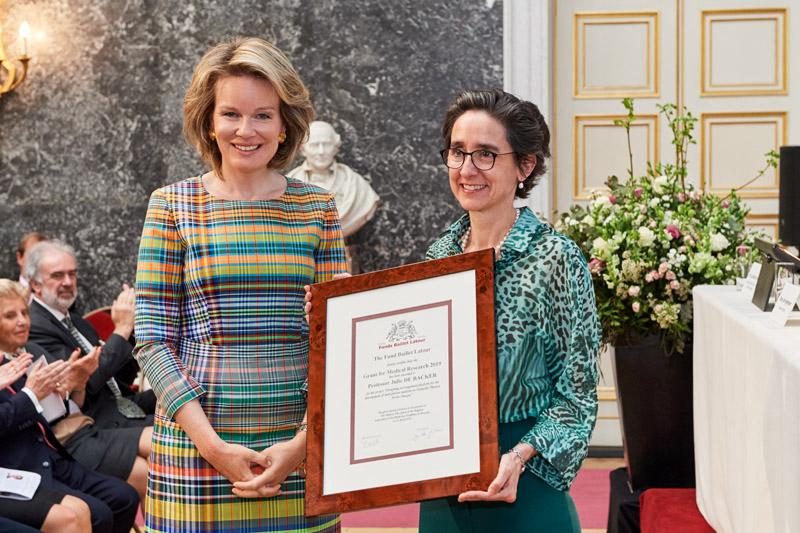 On April 25, 2019, the Fonds Baillet Latour awarded its 2019 Medical Research Credit totaling 750,000 euros to Professor Julie De Backer (Ghent University and Co-President of the Scientific Committee of the 101 Marfan Genomes Project) and its 2019 Health Prize totaling 250,000 euros to Professor Catherine Boileau (Hôpital Bichat and member of the Scientific Committee of the 101 Marfan Genomes Project) at the Royal Academy of Belgium in the Presence of Her Majesty Queen Mathilde of Belgium on April 25, 2019. Yvonne Jousten and Douchka Peyra, respectively Honorary President and President of the Belgian Marfan Syndrome Association, were invited, as were Ludivine and Romain Alderweireldt-Verboogen for the 101 Genomes Foundation.
The awarding of a total of one million euros to Marfan Syndrome specialists Julie De Backer and Catherine Boileau to pursue research into cardiovascular diseases is fantastic news for all those affected by Marfan Syndrome and related diseases. This sum will fuel hopes of improving patients’ living conditions [1].
Hearing Professor Julie De Backer and Professor Catherine Boileau speak about Marfan syndrome in front of Her Majesty Queen Mathilde of Belgium and an attentive crowd of hand-picked guests was a stark contrast to the loneliness that can sometimes be felt when confronted with the disease in a hospital room. In terms ofawarness about disease, we’ve probably rarely done better ! Well done ladies !
In her acceptance speech, Professor Julie De Backer had the opportunity to explain that the project in the field of cardiovascular disease for which she received the Baillet-Latour Fonds Credit consists in ” design an integrated platform for the development of more precise medicine in the field of hereditary thoracic aortic disease ” [2].
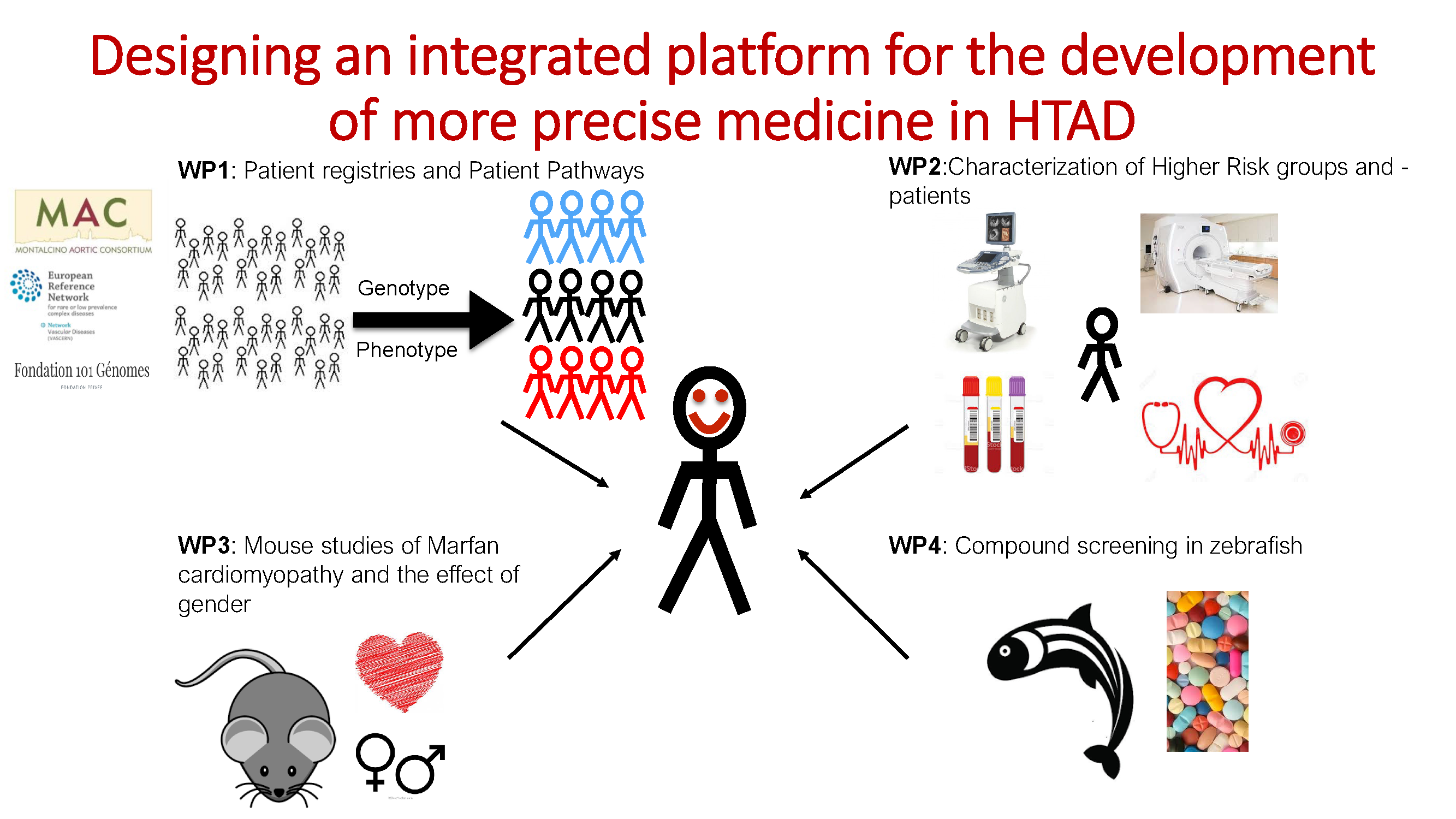
Professor Julie De Backer then described the three dimensions on which this platform is based, namely :
- the European reference network for rare vascular diseases, VASCERN [3];
- the genetic and phenotypic database set up by the Montalcino Aortic Consortium(MAC) [4]; and
- the genomic database set up by the 101 Genomes Foundation (F101G) [5].
The surprise of hearing Professor Julie De Backer explain the role of the 101 Genomes Project dedicated to Marfan syndrome in the architecture of her research, touched us deeply and reinforced the importance of the F101G’s action in enabling science to progress.
[embedyt] https://www.youtube.com/watch?v=v2MkF-bB9L4[/embedyt]
 Professor Julie De Backer went on to describe the research steps that could be carried out using the integrated platform, and concluded by emphasizing the importance of patients in her research and paying tribute to Yvonne Jousten’s investment.
On receiving her award, Professor Catherine Boileau stressed the urgent need to study and better understand the mechanisms at work in rare diseases, as their understanding can lead to the discovery of new therapeutic approaches for these diseases, but also for other much less rare diseases in which similar mechanisms are at work.
 She explained very concretely that her work on rare forms of familial hypercholesterolemia and vascular atherosclerosis had led to the identification of mutations in the PCSK9 gene, whose protective effect could be replicated by the development of inhibitors of this gene, making it possible to propose new cholesterol treatments for the general population [6]. !
Professor Catherine Boileau explained that the aim of her current work is to ” lead to both diagnostic and predictive gravitational tests, and identify new therapeutic targets “[7] for patients with Marfan syndrome. And that’s precisely what she’s working on as a member of the Scientific Committee of the 101 Marfan Genomes Project !
Needless to say, we were all particularly euphoric at the reception that followed the award ceremony !
Congratulations once again to these two great ladies who are advancing knowledge of Marfan syndrome and aortic problems.
What a great day for the Marfan community !
Ludivine & Romain
[1] And in this sense, the passage in the press release accompanying the award of the Credit to Professor Julie De Backer, which mentions her research on TGFβ and especially NO, is particularly encouraging: ” Research by Professor De Backer and his team has already shed light on the underlying causes of cardiovascular damage in these disorders. They have further developed the concept of mechanosignalization and, more specifically, the role of several signaling pathways, including TGFβ and NO ” . http://www.fondsbailletlatour.com/media/misc_media/20190425-CP-FBL_CreditRechercheMedicale-FR.pdf).
[2] Free translation of ” Designing an integrated platform for the development of more precise medicine in Heritable Thoracic Aortic Disease “.
[3] Find out more about VASCERN at : https://vascern.eu/
[4] To find out more about MAC, visit : http://www.montalcinoaorticconsortium.org/
[5] f101g.org
[6] ” In the field of familial hypercholesterolemia (FH), she was the first to postulate and then demonstrate the existence of totally unknown players in cholesterol metabolism. This is how she identified the first gain-of-function mutations in PCSK9, both in FH subjects and in other atheromatous dyslipidemias. This exceptional discovery has led to the development of different classes of anti-PCSK9 therapies. These products are proving to be the most powerful cholesterol-lowering agents since the discovery and use of statins over 30 years ago. ” http://www.fondsbailletlatour.com/media/misc_media/20190425-CP-FBL_PrixSante-FR.pdf
[7] http://www.fondsbailletlatour.com/media/misc_media/20190425-CP-FBL_PrixSante-FR.pdf