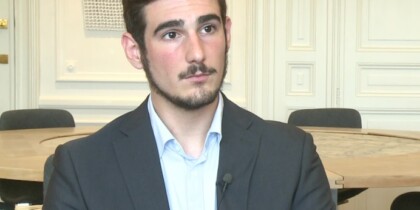
1. Could you please introduce yourself?
My name is Bruno Fonteyn. I’m active in health law, essentially monitoring clinical research, biobanks and that sort of thing. I’ve been working as a lawyer for ten years, and a few years before that I was a member of the Conseil National de l’Ordre des Médecins.
2. Why do you support the 101 Genomes Foundation’s 101 Genomes Marfan Project?
For me, it’s important to take part in P101GM because I feel that patient-led initiatives are probably a little too rare. Constructive initiatives to get patients involved in care in general – although this is often forced and coerced – but also in clinical research and the development of new therapies, seemed to me to be an extremely constructive initiative.
I think it also contributes to the development and deployment of clinical research. It’s a constructive way of helping researchers to develop, for the benefit of all.
3. In practical terms, how can each of us contribute in our own field? We’ve got scientists and lawyers here, but how do they help each other?
In practice, and I think the P101GM is a good example of this, things have become so specialized that everyone’s contribution has become crucial.
Of course, researchers are on the front line, but they can’t work without resources, and patients are the ones who provide them. The patient takes on a very special dimension in a genomic context, in that the patient is you and me, everyone. By searching for these genetic variants, everyone, whether to check the validity of the data or to control the mutation that would be pathogenic, is likely to participate in reality. And that’s what’s interesting, i.e. that there’s certainly room for everyone in this type of research, and it’s even part of a somewhat civic approach to be active in this type of research..
There’s room for everyone, because we obviously have, and this is central, the researchers, and we can even see that among the researchers it’s extremely vast, since there are medical researchers who practice cardiology, ophthalmology, the statistician researcher, The researcher statistician, a pure mathematician who can check whether we’re on the wrong track or on the right track with our research, the researcher geneticist who draws parallels between mathematics and clinical medicine. These are all people who are needed to implement a more global project than pure clinical research alone.
In fact, our aim here is to use Marfan as a pilot project, but to be able to reproduce this approach elsewhere for a whole host of other realities, and particularly for research into rare diseases, which are undoubtedly the poor cousins of research today, given the lack of potential economic spin-offs from this kind of development.
4. What are your expectations of the 101 Marfan Genomes Project?
What would be extraordinary is for Marfan to be the seed for a general platform on which a whole range of people could plug in, with this cooperative, collaborative side where everyone is moving in the same direction. This side is obviously extremely captivating. A second aspect that must not be overlooked is the patient’s underlying initiative. A patient who participates deploys and facilitates the researcher’s task, of course, but it also has an educational virtue: the patient is a necessary megaphone to communicate to other patients the fact that it’s open to all. This ” patient empowerment “, which is much talked about in medicine today, is a powerful vector for improving and involving people in what concerns them first and foremost. Clinical research is, of course, first and foremost about patients.
[embedyt] https://www.youtube.com/watch?v=XdXa4QbbcaE[/embedyt]
[embedyt] https://www.youtube.com/watch?v=FZyWFaCrJDw[/embedyt]