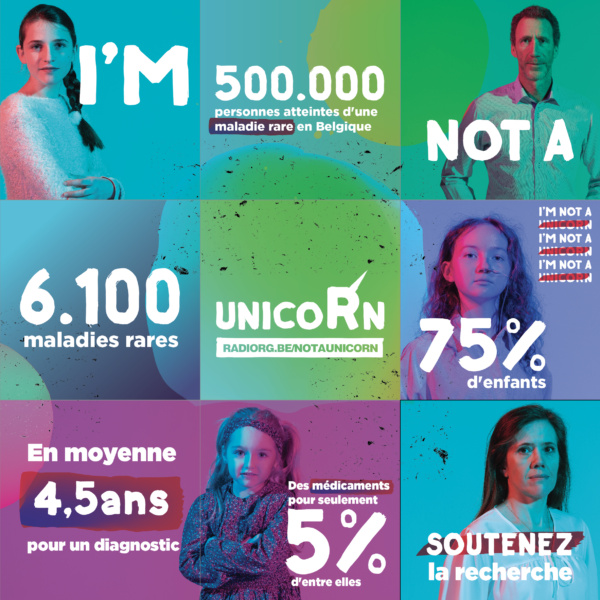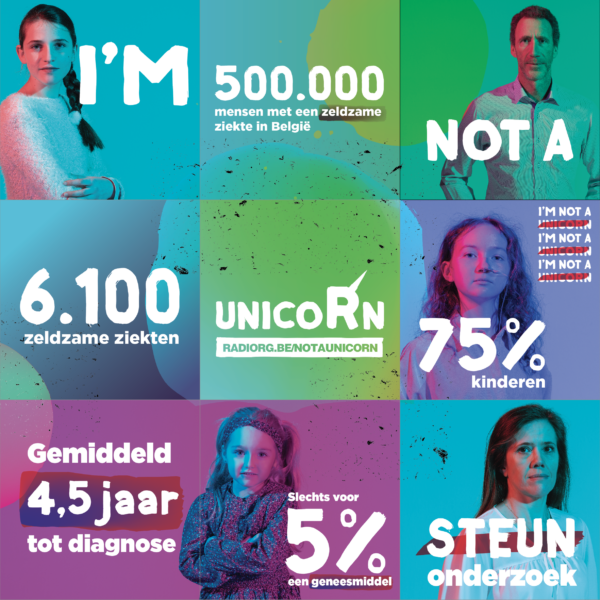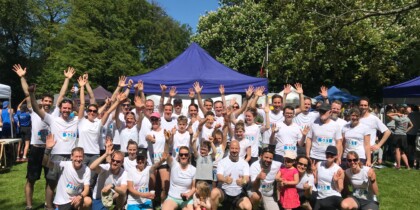
With the ‘I’m not a unicorn’ campaign, RaDiOrg reminds us that, although they are often invisible, people with rare diseases really do exist…unlike unicorns. For the first time, this national campaign will benefit the 8 Belgian rare disease hospitals. Find out more about its challenges, objectives and how the F101G is playing its part..
Since 2019, Ludivine has represented the Belgian Marfan Syndrome Association(ABSM) and the 101 Genomes Foundation at RaDiOrg. RaDiOrg is the umbrella association for rare disease patient organizations in Belgium. Ludivine has been invited to join the RaDiOrg Board of Directors, where she holds the position of Vice-President(Team RaDiOrg).
Under the impetus of its director, Eva Schoeters, RaDiOrg launched the ‘I’m not a unicorn‘ campaign this year to raise public awareness of the cause of rare diseases(#notaunicorn).
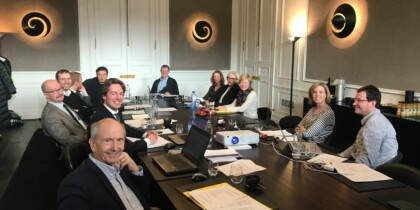
For the first time, the CHU de Liège, the UZ Gent, the Hôpital Erasme, the UZ Brussel, the Cliniques Universitaires Saint Luc, the UZ Leuven, the Grand Hôpital de Charleroi and the UZA – i.e. the 8 Belgian “rare disease function” hospitals – have rallied around the campaign initiated and the message carried by RaDiOrg (8 Centers).
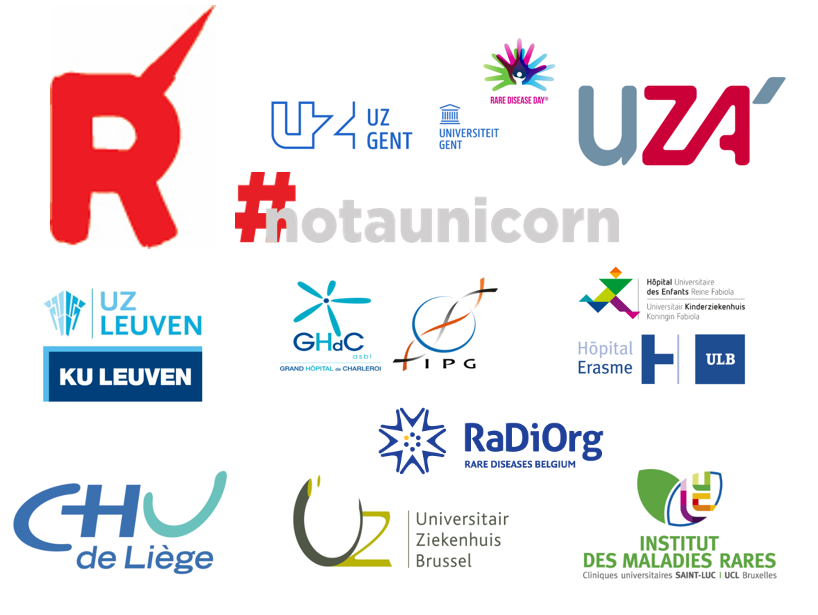
Fourteen pharmaceutical companies (Boehringer Ingelheim, Chiesi, Gilead, Janssen, Novartis, Pfizer, Roche, Sanofi, Sobi, Takeda, UCB, Ultragenyx, Biogen, Bristol Myers Squibb), pharma.be (the general association of the pharmaceutical industry) and the National Lottery are supporting the #notaunicorn campaign(Sponsors).
The aim of the campaign is to raise public awareness :
- That there are over 6,100 rare diseases
- Medicines are available for only 5% of them
- Patients wait an average of 4.5 years for a diagnosis
- 75% of people with rare diseases are children
- That there are 500,000 people with rare diseases in Belgium
- That research into rare diseases must be supported
Even if they are often invisible, rare disease patients are not unicorns. They really exist, and they’re all around us. These non-unicorns have an enormous amount to teach us about humanity (and not just scientifically)..
It’s up to us to listen to them and find the means to fund research!
F101G