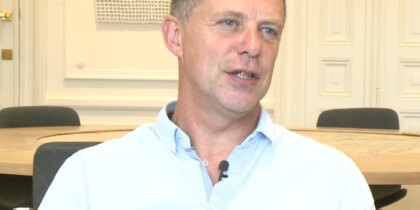
“A pilot project that can be extended to other diseases” by Dr. Verboogen
1 Can you introduce yourself?
My name is Michel Verboogen, I’m President of the F101G and I’m also Aurélien’s grandfather. In real life, I’m a doctor specializing in psychiatry.
2. Can you tell us about the 101 Marfan Genomes Project?
The P101GM project involves comparing phenotypic data, i.e. a patient’s medical characteristics, with genome analysis, i.e. the entire gene map available in an individual. In fact, current research has made great strides in this area, since obtaining genomic maps quickly and easily is a fairly recent development.
3. Why did you agree to join the Scientific Committee of the 101 Genomes Foundation’s Marfan 101 Genomes Project?
I’m not here in a scientific capacity. I well remember Romain’s phone call when he asked me to take part in this work he was about to undertake, which seemed completely colossal to me at the time, but I had already prepared myself internally, deciding to say yes if he asked for help. I’m here above all as a father and grandfather. Ludivine and Romain launched this project, which I found and still find fantastic, and I said I would help them with all my soul, all my heart and all my strength. That’s how I see myself in this project. In fact, they didn’t need me that much, as I watched them study the genetics, ethical and IT components surrounding this project, and was completely amazed by the way they accumulated scientific knowledge in particular.
4. This is a project that touches you personally. What are your hopes and expectations of the 101 Marfan Genomes Project?
Of course, all medical research is important, and in this case it’s really important to us because it concerns the family. I sincerely hope that research will move forward quickly. And I’m full of hope because when I meet the researchers and see their dynamism and enthusiasm, I tell myself that it’s going to produce results pretty quickly. I hope that research will make rapid progress for all those suffering from rare diseases, of course, and especially for my grandson.
5. The interviewees were unanimous in their admiration for the energy invested by Romain and Ludivine in this project. I imagine you feel it too?
Their energy amazes me. I’d never have imagined it. At first, when they explained to me what they wanted to do, I thought : ” my god, it’s a colossal task ! ” Then I saw them move forward at their own pace, with an incredible dynamism, because you have to realize that their son requires a lot of time too, there are a lot of medical visits, a lot of care to give. They found the time and energy to give to this project.
It’s a project that requires a lot of knowledge and quite a lot of intelligence, because there are a lot of things to understand, medically speaking, there are a lot of things to understand in order to be able to discuss with these high-flying scientists… And then there are the other areas too, apart from the medical, there are the ethical, legal, IT and then the financial, there’s a whole financial battle to be fought, although here I’ve been very pleasantly surprised by the generosity of many people, whether in the place where I practice or in institutions or in the family, everyone has pitched in.
In fact, it was someone close to me who started the process. We had the idea of launching the project and then someone, without informing anyone, deposited a rather large sum of money in a bank for the project. When Romain and Ludivine heard about it, they said to themselves that it was a starting signal, a trigger for the project, and that there was no time to lose!
6. For people who don’t quite realize what Marfan disease is, could you explain what it involves on a day-to-day basis?
It’s a disease that affects many systems. The cardiovascular system needs to be monitored very regularly, in particular the heart and the aorta, which dilates, so every three months, this dilation of the aorta needs to be measured to see if it’s evolving too quickly.
In Aurélien’s case, it’s the bone problem that’s the most complex right now, with the development of a fairly significant scoliosis that needs to be corrected by physiotherapy sessions and a whole series of corsets and casts, and also later by surgery. The scoliosis is such that it starts to compress the lungs and heart, so something has to be done.
Aurélien has to wear glasses with fairly high corrective lenses, but the eyes need to be monitored too, as the lens can shift later on.
And then there’s the problem of the ligaments, which we call hyperlaxity, meaning that the ligaments are too supple, too elastic, which puts the individual at risk of sprains or strains later on. So Aurélien wears ankle boots that support his ankles.
So there’s a lot of care to be given, there’s medical equipment to be found, there are opinions to be sought because it’s a rare disease, so doctors aren’t necessarily familiar with Marfan syndrome. I, for example, vaguely remember studying it in school, but then you forget. You really do need to bring a patient to your practice by chance, so that you can review the scientific information on this disease, which, as with all rare diseases, is normally overlooked.
7. What do you see as the key element that makes the 101 Marfan Genomes Project important for Marfan patients? What about other rare diseases?
Our hope is that this will be extended to other diseases. If we raise more funds, we could extend our scope to other diseases, since these are families of diseases, many of which affect the heart.
Here, for example, at today’s Scientific Committee meeting, we’re talking a lot about cardiology, because if there’s a dissection of the aorta, you can have sudden death. The most serious is cardiac monitoring, while other problems can be monitored more attentively. In the end, I became passionate about what was going on.
At the same time, it’s a sad story for our family, but at the same time, it’s an exciting story for us to be able to stimulate research like this. And I’d really like to see it extended to other rare diseases – that’s my dearest wish – that it could be a pilot project that could be extended to other diseases and other countries..
In any case, it’s off to a flying start, that’s for sure, it’s gone surprisingly fast and I’m delighted about that. But there are scientific, legal and consent complexities, as well as IT and financial ones, because it takes a lot of work to contact people and make ourselves known in order to raise funds. Romain and Ludivine have done all this very well. They don’t hesitate to get in touch with lots of people, to involve lots of people, they dare to speak out, they dare to reach out. I also admire their boldness in this area.
8. Do you have a conclusion to add?
I am optimistic about this project for three reasons:
- The dynamism and enthusiasm not only of the project leaders, but also of the researchers who joined us. And I’d like to thank them very much, because they’re here, from Paris and several Belgian universities.
- The genome is right up there with the timesSince I entered this world thanks to the Foundation, I’ve realized that there’s a lot of talk about the genome in scientific journals and even in the media, and that there are projects all over the world, in England, Dubai, Iceland and elsewhere. I see a lot of movement.
- The generosity I meet, from large structures, medium-sized structures and individuals.
[embedyt] https://www.youtube.com/watch?v=J7geBW4mtcA[/embedyt]