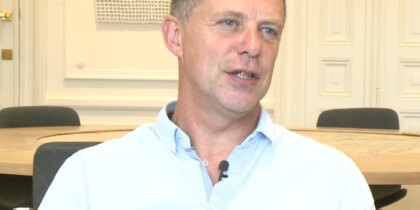
“Out of the three billion letters that make up the DNA of a genome, we understand only a small part” by Prof. Dr. G. G. Guillaume Smits
1. Could you please introduce yourself?
I’m Dr Guillaume Smits, a geneticist with extensive laboratory and research training. Most recently, I worked for eight years at the Huderf Reine Fabiola Children’s Hospital as a pediatric geneticist, where I had the opportunity to meet Mr and Mrs Alderweireldt-Verboogen, who set up the 101 Genomes Foundation.
2. Can you tell us about the 101 Marfan Genomes Project?
P101GM is based on the idea that – even if today it is easy to diagnose Marfan disease because we know the gene very well and clinical signs help to identify patients. – It is, however, difficult to understand why some patients present more severely than others.
Ideally, we’d like to be able to personalize drug treatment for certain patients and find new drug candidates.
Today, the genome is an incredibly powerful tool for finding missing information and creating new knowledge in a very simple way: simply sequence patients’ genomes. But we need a lot of patients.
3. Why did you agree to join the Scientific Committee of the 101 Genomes Foundation’s Marfan 101 Genomes Project?
I think it was a no-brainer: having met Mr and Mrs Alderweireldt-Verboogen in my capacity as their geneticist, I had to answer their questions. What happened very naturally was that, given the parents’ curiosity, I started spending time with them to give them the means to understand the disease, to understand genetics, to understand what a rare disease was.
And then they went on to understand even more, and went into some very impressive scientific reading. Now Mr Alderweireldt has the knowledge to write scientific journal articles, to understand almost everything that researchers and doctors do.
Afterwards, Mr and Mrs Alderweireldt-Verboogen became involved in F101G, and it was an obvious choice to follow them in their project, which I hope will go a long way in conveying the message of the importance of genome knowledge, of the importance of the genome for patients with rare diseases, and of the importance of the genome in bringing hope for personalized therapies.
4. As a scientist, what do you expect from the 101 Marfan Genomes Project?
As a scientist or doctor, the advantage of the whole genome today is that it provides a single tool for both clinical diagnosis and, at the same time, almost infinite research capacity. Out of the three billion letters that make up the DNA of a genome, we understand only a small part. It’s like having increasingly powerful telescopes: you end up with an incredible amount of data that scientists and clinicians can then put into perspective by accumulating data on patients’ symptoms, making it possible to establish strong links between genomic variants, the biology of the disease and patients’ phenotypes. Once you have the patient’s genome, it’s there for years and years, and you can do and redo research in their three billion bases.
The advantage of the P101GM project is that a simple high-quality genome sequencing will enable years and years of research in many different directions; the research resource will be available, stable, and both scientists and clinicians will be able to use it. This simplicity is the strength of the F101G project: trying to raise money to sequence genomes and make them available in a controlled way for scientists or clinicians who need them to advance knowledge about Marfan disease, and perhaps even extend it to other types of rare diseases that could also benefit from knowledge of the genome.
The incredible work of Mr and Mrs Alderweireldt-Verboogen is that they have already succeeded in bringing together a fine consortium of Belgian and French scientists. They are in the process of extending it to the Netherlands, England and the whole of Europe. As far as genomes are concerned, this also provides knowledge and visibility for the general public. The F101G highlights the simplicity of the genome and the incredible resource it represents for future research.
5. What do you see as the key element that makes the 101 Marfan Genomes Project important for Marfan patients? What about other rare diseases?
The P101GM is the pilot project for the F101G, which for the first time has to face up to all the logistical, legal, political, financial and other problems involved in bringing all the different forces (scientific and otherwise) to the table. All this can be learned from this pilot project. In this way, the F101G will have acquired knowledge that will enable it to help other projects much more rapidly, either for rare diseases or even for more common diseases that also require sequencing of patients’ genomes. .
Professeur Guillaume Smits, M.D. PhD
Department of Genetics’ Director, Hôpital Erasme, ULB Center of Human Genetics,
Université Libre de Bruxelles, Brussels, Belgium
(IB)² Interuniversity Institute of Bioinformatics in Brussels, Université Libre de Bruxelles, Brussels, Belgium
Cette publication est également disponible en :