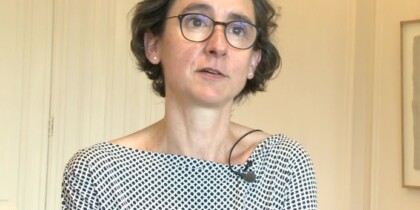
“Trying to better treat and prevent complications of the disease” by Prof.. Catherine Boileau

1. Could you please introduce yourself?
I’m Catherine Boileau. I’m a geneticist and head of the genetics department at Hôpital Bichat in Paris.
2. Can you tell us about the 101 Marfan Genomes Project?
The P101GM project involves the first ever complete genome sequencing of the hereditary material carried by 101 Marfan patients. So it’s really quite innovative, and we’re expecting a lot.
3. Why did you agree to join the Scientific Committee of the 101 Genomes Foundation’s Marfan 101 Genomes Project?
As a geneticist, I’ve been working on Marfan syndrome for a long time. The initial question we asked ourselves a long time ago was : ” What causes Marfan syndrome? “. This question was answered in the early 90s, when it was shown that mutations in the gene encoding the protein called Fibrillin 1 are responsible for the disease.
By answering this question, we could propose a laboratory diagnosis. But little by little, we realized that with this diagnosis, we had taken a big step forward, but that we couldn’t answer the question: what form will the disease take, what will the person carrying the inherited mutation do, will it be serious, not serious, etc.?
And that’s really the challenge at the moment: trying to understand why the disease won’t have the same severity from one person to another. This is very important not only for monitoring patients and for better monitoring them and knowing which ones will need to be monitored very closely, but also perhaps, having understood, to have more effective drugs that will allow us to better treat and prevent the complications of the disease. .
4. As a scientist, what do you expect from the 101 Marfan Genomes Project?
Of course, the expectations are those of the patients. As a researcher and someone involved in diagnosis, my expectation is to understand better and, in terms of diagnosis, it is, as I do now, to determine whether the patient is a carrier or not of the mutation but also to be able to specify the possibility that the disease is serious or not serious.
5. What do you see as the key element that makes the 101 Marfan Genomes Project important for Marfan patients? What about other rare diseases?
This project is a model for other rare diseases. Why? Because the problem with rare diseases is exactly what the word “rare” says. In rare diseases, to do research, we need to bring together many teams to work together because the number of people we can work on is small and therefore all the statistical tests that are necessary to validate the results are lacking because the samples we have are few.
The model we’re putting in place with P101GM is a model that enables us to adapt a research strategy to the problem of patients who represent only a small number of patients.
For example, a research project involving a very common disease such as myocardial infarction is very common worldwide, and in one country there are more than enough people suffering from myocardial infarction to constitute a population sample on which to work. This is not at all the case with rare diseases, so we need to find ways of being effective. If successful, this research project should enable us to propose a model for other rare diseases.
Professor Catherine Boileau, PharmD PhD
CRMR Marfan and related syndromes, Cardiology Department (G.J., C.B.),
Laboratory for Vascular Translational Science, INSERM U1148 (G.J., C.B.) and
Department of Molecular Genetics (C.B.), Bichat Hospital, Paris, France
Cette publication est également disponible en :