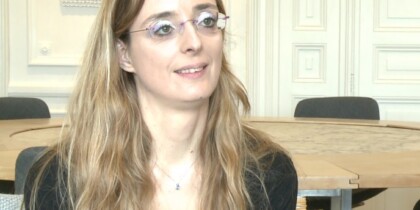
“For me, better informing and treating the patient is the overriding goal” by Prof. Dr. G. B. Julie De Backer

1. Could you please introduce yourself?
I’m Julie De Backer. I’m a cardiologist and clinical geneticist at Ghent University Hospital.
2. Can you tell us about the 101 Marfan Genomes Project?
P101GM aims to find a correlation between clinical and genetic damage in Marfan syndrome in the first instance and then, in the longer term, in other diseases. Identifying a relationship between the two is the main goal. Many researchers have already made numerous studies on this subject, but in view of the new genomics technologies in which there has been a spectacular evolution in recent years, it is very important to introduce these new techniques into current genotyping-phenotyping research.
3. Why did you agree to join the Scientific Committee of the 101 Marfan Genomes Project?
I’ve been involved with Marfan syndrome since 2001 and have always been very interested in the question of the correlation between genotype and phenotype. It was therefore out of scientific interest that I decided to join the P101GM Scientific Committee, but above all to be able to respond to the need to better inform patients about the risks of their disease by identifying these risks more reliably thanks to new genomics technologies.
4. As a scientist, what do you expect from the 101 Genomes Foundation’s 101 Marfan Genomes Project?
As a scientist, I hope we’ll have more ways of informing patients more reliably than we do now. There are always clinical cases where tragedies happen because we lack the means to predict which patients will have which type of disease evolution. For me, better information and better treatment for patients is the overriding goal. .
5. What do you see as the key element that makes the 101 Marfan Genomes Project important for Marfan patients? What about other rare diseases?
For years, in medicine, everyone has been trying to find factors that can help predict risk. Of course, environmental factors play a role (sex, hypertension, etc.), but as for genetic aspects, I hope we will find gene modifiers that can help us predict risks. Even if it’s just one factor, it will already be a big step in the right direction.
Professor Julie De Backer M.D. PhD,
Center for Medical Genetics, University of Ghent and Ghent University Hospital, Ghent, Belgium
Department of Cardiology, University of Ghent and Ghent University Hospital, Ghent, Belgium
Cette publication est également disponible en :